
July 5, 2026
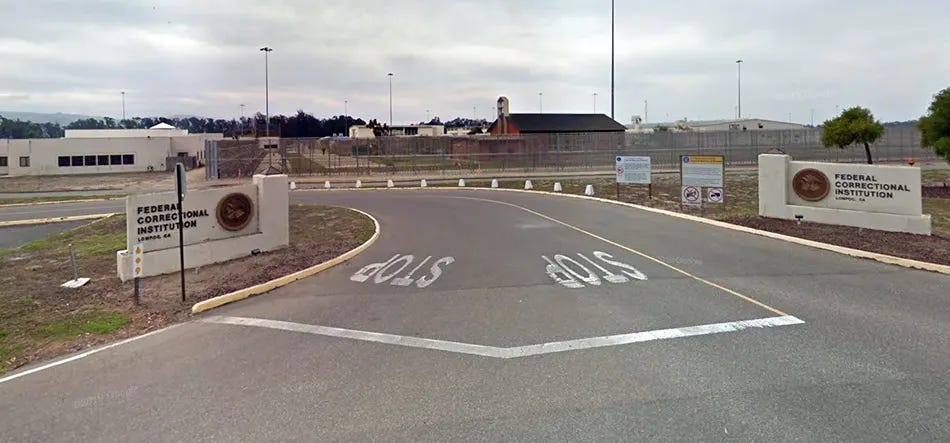
Joe and I drove down to Lompoc Federal Prison yesterday to see Sam. No need to comment on the irony of visiting him on Independence Day. The prison at least had the good taste not to organize a July 4th celebration for its involuntary, disenfranchised population.
The logistics of our visits have gotten much easier since Sam was moved from Terminal Island to Lompoc. Lompoc is 2 ½ hours closer to the Bay Area, where we live. The staff at Lompoc is much nicer to visitors. There are rarely any lines to get in, no doubt because Lompoc is in the middle of nowhere, too far from most inmates’ families for them to make the trip regularly. One couple we talked to yesterday hadn’t seen their son in a year, because they live in Idaho (which has no federal prisons) and Lompoc is a 16-hour drive from them.
Another pleasant surprise: I’d never spent time in the Central Coast of California, where Lompoc is located. It is beautiful, in a quiet and slightly haunting way, bounded by coastal mountains on the west and inland mountains on the east. In between, the countryside is mostly rolling hills dotted with high chaparral and the very occasional vineyard or farm. Inmates at Lompoc can get a glimpse of the hills on the other side of the barbed wire.
In the end, it is still a prison. Being able to visit Sam is a godsend, but it is also very hard on me. The two demons I have to fight off in my daily life are grief and anger, each debilitating in its own way. It is impossible to keep them at bay while I am there, and they usually linger for a day or two after. They are still with me now. The still, timeless, feel of Lompoc makes it much too easy to imagine Sam there a decade from now, nothing changed, his life stolen from him, the waters long ago closed over the wrongs done to him. In most peoples’ minds, the waters are already mostly closed. The lawyers and prosecutors who framed him are just about home free from any repercussions for their actions. The former FTXers who testified against him have all moved on with their lives, building families and rebuilding successful careers. Do they think about Sam, I wonder? Do they ever feel guilt or regret? Do they think about Ryan Salame, the other FTX fall guy, now serving a 7 ½ year sentence for crimes he didn’t commit? Or have the waters closed over the past for them as well?
In an earlier substack post, I shared an entry from Sam’s prison journal in which he vowed never to become an “innie”-- someone whose vision of the possible has shrunk to fit what is possible within the four walls of a prison: trading a flat of stamps (prison currency) for a homemade, contraband pillow (federal prisons don’t provide them), securing fresh vegetables from the kitchen to add to the Ramen noodles which he subsists on because the prison doesn’t provide vegan food. As we talked yesterday, I watched closely for signs that his resolve is slipping, that the real Sam is slowly being destroyed. I don’t see any, but I also know that he would fake it for as long as he could for our sakes. He still talks about prison life with ironic detachment, and still willingly engages in conversations about the outside world, although increasingly prefaced with the warning that since he hasn’t been able to update his knowledge about the world in the past three years, his opinions might not be worth all that much any more. As we ply him with information about doings on the outside, I worry it is more painful than not for him to hear.
Leaving him is always hard-- both saying goodbye, and the surreal insanity of the moment where we walk out the prison gate and Sam doesn’t. A mother I have become close to says that as hard as she tries not to, she always cries when she says goodbye. I usually hold it together at least until we are out of eyeshot of Sam, and sometimes for hours after. Eventually it catches up with me.
Tonight we are having dinner with friends-- a longstanding Sunday ritual that has helped keep us sane over the past 3 ½ years. By tomorrow, I will be back to (my new) normal. I will see reasons for hope, and also recognize that there are still things I can do that could make a difference. I will remember that all of the people who testified against Sam were victims themselves, put in an impossible position. I will refrain from using words like “framed” and “fall guy,” however accurate they might be, in favor of cooler prose, and try to be the voice of reason and hard facts. I will write Sam to update him on the case and pass along some news from the outside world that I hope will distract him from his life at least momentarily.
Federal prisons allow family members and inmates to hug when they meet, but require them to sit on opposite sides of the table during the visit. The rule is strictly enforced. It was a beautiful day yesterday, and Sam, Joe and I sat at one of the outside tables, a hawk lazily circling overhead. At a nearby table there was an inmate and four family members-- mother, wife, and two young children. When they first greeted each other, the inmate had swooped the kids up in his arms, the kids squealing with happiness and hugging him for dear life. Now, mother, wife and kids were squeezed on a bench on one side of the table and the inmate was sitting alone on the other. A guard came outside and headed for their table. We watched, curious. We couldn’t hear what the guard said, but as she turned to leave, the two children jumped up and ran around the table to sit on either side of their dad, who put his arms around them. Joe and I looked at each other, both tearing up. Even in hell, there are moments of grace.